
Escape and Rescue from Submerged Vehicles
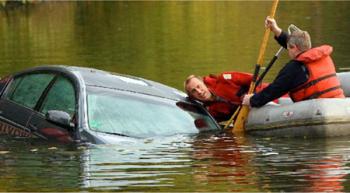
Each year within the United States, there are 1,200 – 1,500 submerged vehicle incidents resulting in 400 – 600 deaths. Therefore, we encourage the public to plan for these types of emergencies.
Preparing For Vehicle Submersion in Water
There are two simple steps to preparing for an incident where your vehicle becomes submerged under water.
#1 Rehearse
The first step is to rehearse the steps necessary for a successful self-rescue from a vehicle in the water
#2 Proper Tools
Ensure that you have the rescue/escape tools readily available and accessible for use during this type of emergency.
First Responder Training For Submerged Vehicles
Fire, police, EMS and other first responder agencies need to provide the training necessary to prepare their personnel to respond to these types of incidents. (Lifesaving Resources provides this training!) Additionally, these First Responders should be provided with the Personal Protective Equipment (PPE) and rescue tools necessary for a safe and effective response to vehicles in the water.
Emergency dispatchers need to be educated to instruct callers to immediately get out of their vehicles if the vehicles are in danger of sinking.
Understanding Dangers of Water When Driving
Public service campaigns should be increased in an effort to educate the public about the risks of driving through flooded highways; driving in close proximity to bodies of water during snow, rain or other slippery conditions; or driving over lakes, rivers or ponds that have frozen over. The following information should be included in these efforts:
- It only takes approximately 6” to sweep a person off his/her feet, and it only takes 1′ to 2′ of water to float a vehicle off its wheels. Drivers need to heed warnings about low water crossings and do not attempt to cross flooded highways.
- 8” to 12” of new, clear, hard ice is required to drive a small vehicle onto the ice. 12” to 15” of new, clear, hard ice is required to drive a medium-sized truck onto the ice.
- Wearing seat belts will increase your chances of surviving a crash into the water.
What Happens When A Car Lands In Water?
If a vehicle leaves the road and lands in deep water, most passenger vehicles will float on the surface for a short period of time (from 30 seconds to several minutes).
But, all vehicles will sink! If the water is deeper than the height of the vehicle body, it will submerge and disappear beneath the surface.
Factors which effect the float time include closed, sealed, and intact windows and weather seals, as well as the design, body style, construction quality, and the condition and age of the vehicle.
Because of the location of the motor in the front of the vehicle, the vehicle will immediately assume an angled nose down position in the water.
A vehicle with the windows and/or doors open will submerge faster than the same vehicle with its windows and/or doors closed. The faster the water enters the interior of the vehicle, the faster it loses its buoyancy and the quicker it descends.
A vehicle that has all the windows and doors closed will initially descend slowly, but as the vehicle loses buoyancy its speed of descent will increase.
Escaping A Car During A Water Emergency
Because of the relatively limited time frame for self-rescue, the decision to escape the vehicle must be made immediately.
However, because of the angled nose-down position in the water and the pressure exerted by the water against the doors, as well as structural damage to the vehicle caused from the crash, it may be extremely difficult or impossible to open the driver’s side and passenger doors of the vehicle in order to effect an escape. Therefore, the only avenue of escape may be through the car door windows.
Studies have shown that the electric power may stay on inside the vehicle for as much as an hour. However, once the window motors and/or switches get soaked, they will generally short out and the windows and electric door locks will no longer operate. Therefore, in order to escape through the car door windows, the occupants must be able to punch/break out the windows. If the side door windows are constructed of tempered glass, they will easily shatter using an appropriate rescue/escape tool, such as a life hammer device, or a spring-loaded window punch (i.e. ResQMe). Many of the commercially available rescue/escape tools also have an integrated seat-belt cutter/blade that provides the ability to slice away a seat belt should its release mechanism fail or jam.
The decision to escape the vehicle must be made as soon as the vehicle leaves the road and enters the water. If the occupants delay their escape from the vehicle and the vehicle begins to sink before an escape route has been established, it may not be possible to effect an escape until the water pressure has equalized inside the vehicle. By that time, it is typically too late.
Also, should the vehicle land in deep water, if the water depth is less than 14′, the vehicle will usually come to rest on the bottom on all four wheels, assuming there are no large rocks or other debris on the bottom. However, water depths greater than 14′ usually results in the vehicle turning turtle and landing upside down on its roof. Needless to say, being upside down in a dark environment with water rushing in will totally disorient the occupants of the vehicle.
Car Submersion Survival Messaging
In order to advocate a single universal message to educate the public on how to escape from a submerging vehicle, we advocate the following:
SEATBELTS (off)
WINDOWS (open/break)
CHILDREN (removed)
GO (get out!)
These emergency procedures should be rehearsed before the emergency occurs.
- Use a body reference point to identify and locate the door latch, window crank or electric window switch. As an example, the driver should practice finding the location of these by touching his knee or hip with his/her left hand and then move the hand laterally to the door.
- A rescue/escape tool should be immediately available for punching out the window and cutting seatbelts. This tool should be mounted on the sidewall of the driver’s side compartment, attached to the key ring, or located in some other conspicuous location that can be easily accessed during an emergency. Consideration should be given to additional tools for the passenger side and rear seat compartments as well. (Note: the ResQMe spring-loaded window punch is designed to be attached to the key ring, so it is always accessible to the driver.)
- If there are multiple occupants, once an escape route has been established, each occupant should hold hands to form a human chain and everyone should exit from the same route. If young children are secured in car seats, the seat belts should be removed or cut and the child removed. (Note: some car seats are sufficiently buoyant to float a child to the surface. But, you should check with the manufacturer to determine whether or not your car seats are sufficiently buoyant to do so.)
There is no doubt that when a vehicle leaves the roadway and plunges into the water, this would be an extremely frightening experience, especially during the winter months with cold water posing additional risks and hazards to the occupants. But, by rehearsing the emergency escape and survival procedures and having the rescue/escape tools readily available, occupants can rapidly self-extricate themselves from this situation before the vehicle begins to sink.
Rescue Protocol for Submerged Vehicle
Public Safety and Rescue personnel should be appropriately trained, protected, and equipped to effectively and safely respond to vehicles in the water.
Besides the availability of Personal Flotation Devices (PFDs), Wetsuits and/or Dry-Suits, rescue personnel should have the tools readily available to break or cut the vehicle’s windows in order to rapidly extricate a victim or multiple victims from a vehicle in the water. Spring-loaded window punches (i.e. ResQMe) or life hammer type devices with seat-belt cutters provide the rescuer with the opportunity to gain immediate access to the victims and to cut away the victim’s seat belt for their immediate extrication from the vehicle. However, these devices will not be effective on laminated glass and are only effective with tempered glass windows.
As standard protocol, whenever a rescue agency is dispatched to respond to a vehicle in the water, the dispatch of a wrecker should be automatic in every community and emergency response system. Upon arrival of the wrecker, it can be used to assist in the stabilization of the vehicle during and after the rescue of the vehicle occupants, as well as for the recovery of the vehicle.
Dispatcher Protocols for Submerged Vehicle Incidents
All emergency dispatchers should be trained in this subject and should be prepared to give self-rescue and escape instructions to the callers prior to the arrival of Fire and Rescue personnel. The instructions provided by the dispatcher should include:
SEATBELTS (off)
WINDOWS (open/break)
CHILDREN (removed)
GO (get out!)
Laminated vs. Tempered Glass
Presently, most U.S. manufactured vehicles were constructed with tempered glass in the side doors, whereas, most European vehicles have been manufactured with laminated glass. However, there is a movement to begin manufacturing all vehicles in the U.S. with laminated, rather than tempered glass.
Beginning with a phase-in period that started in September 2013, with full compliance by 2017, automobile manufacturers are required to comply with a test in which an impactor is propelled at up to four locations from inside the perimeter of the side windows in the first three rows of a test vehicle at two time intervals following deployment of the side airbag. The ejection mitigation safety system is required to prevent the impactor from moving more than a specified distance beyond the plane of a window.
The Final Rule, published in the Federal Register in January 2011, does not mandate laminated glass, but it does establish performance requirements, which may lead to a particular technology, namely, laminated glass.
If the manufacturers begin installing laminated, rather than tempered glass, although the number of incidents will not increase, the number of fatalities will certainly increase as hammer-type devices and spring-loaded window punches are NOT effective on laminated glass. This will make escape and self-rescue almost impossible, and will hinder efforts of rescue personnel to access the trapped occupants.
Submerged vehicle stories in the news
WCSH NEWS STORY (July 2013)
The tragic story of a double-drowning incident that occurred in 2013 in Roque Bluffs, Maine. Access the video on YouTube at: https://www.youtube.com/watch?v=geVTxQXSeKc&feature=youtu.be
ABC WORLD NEWS REPORT WITH DIANE SAWYER
http://abcnews.go.com/WNT/video/car-sinking-water-seconds-react-18810014
NBC TODAY SHOW
http://www.youtube.com/watch?v=HGv3OP3yRlA
PO-GO & SOS-GO Terminology Phased Out
Prior to March 2013, Lifesaving Resources was advocating either PO-GO or SOS-GO, with the bottom line being to GET OUT of the vehicle as soon as possible. However, it was brought to our attention that these acronyms may not translate properly into other languages. So, for these reasons we’ve decided to phase out these protocols. However, we know these protocols work and they are basically the same as the new protocols described above.
PO-GO
- Punch open the seatbelt
- Open the window
- GET OUT
SOS-GO
- Stay call and Assess the situation
- Open the window or door
- Disengage the Seatbelt
- GET OUT
AAA study puts vehicle-escape tools under scrutiny
Russell Kent, July 25, 2019 Galion Inquirer
COLUMBUS — Not all tools designed to help break car windows in an emergency work on all types of glass, according to a new AAA study. Consumers should be aware of what type of car windows they have and develop a plan for exiting the vehicle, in case they become trapped.
In 2017, nearly 21,000 vehicles caught fire or became partially of fully submerged in water, across the U.S., resulting in 1,800 deaths. Incidents like these become fatal when occupants are trapped and unable to exit the vehicle. Vehicle escape tools are designed to help occupants break through side windows, so they can exit the vehicle.
Not All Windows Are Made the Same:
Most vehicle side windows are made from tempered glass, which shatters when broken. However, an increasing number of vehicles are being built with laminated glass, which is nearly impossible to break.
Vehicle manufacturers are using laminated glass in response to federal safety standards aimed at reducing occupant ejections in high speed collisions, which are more common than vehicle fires or submersions. One in three new 2018 vehicle models have laminated side windows.
Testing Vehicle Escape Tools:
AAA conducted research to evaluate the effectiveness of a variety of vehicle escape tools to break both tempered and laminated side window glass. Researchers tested a total of six tools, three spring-loaded and three hammer-style. Key findings include:
- Tempered glass – four of the six tools were successful in breaking tempered glass
- All three spring-loaded tools tested passed all attempts to break the glass.
- One of the hammer-style tools broke the glass.
- Laminated glass – none of the six tools tested were successful in breaking laminated glass, indicating it is nearly impossible to break without specialized equipment.
During multiple rounds of testing, spring-loaded tools were more effective in breaking tempered glass than the hammer-style. AAA also found that extra features on tools, such as lights or chargers, do not improve the performance of the tool itself.
Consumer Advice:
Being prepared in an emergency can greatly improve the chances of survival. AAA strongly recommends drivers do the following.
- Memorize the type of glass vehicle windows are made of: Drivers can determine this by first checking for a label in the bottom corner of the windows that indicate whether the glass is tempered or laminated. If this information is not included or there is no label at all, contact the vehicle manufacturer. Some vehicle are outfitted with different glass at varying locations in the car. Most vehicles have at least one tempered window. This will be the best point of exit in an emergency. Remember, standard escape tools will not break laminated glass.
- Keep an escape tool in the car that the driver is comfortable using. Test the tool ahead of time on a softer surface, such as a piece of wood. The tool works if the tip impacts the surface, leaving a small indent in the material.
- Plan an exit strategy in advance. This will help avoid confusion in an emergency, which could increase the time it takes to exit the vehicle. Also have a backup plan in case an escape tool cannot be used or doesn’t work.
If trapped in a vehicle, remember there is a S-U-R-E way out:
Stay calm. While time is of the essence, work cautiously to ensure everyone safely exits the vehicle.
Unbuckle seat belts and check to see that everyone is ready to leave the car when it’s time.
Roll down or break a window. If the car is sinking in water, once the window is open the water will rush into the car at a faster rate.
If windows can’t be open or broken, move to the back of the vehicle or wherever an air pocket is located. Stay with it until all of the air has left the vehicle. Once this happens, the pressure should equalize, allowing occupants to open a door and escape.
If the vehicle is submerged, a hammer-style escape tool could be much harder to swing underwater than a spring loaded tool.
Exit the vehicle quickly and move everyone to safety.
Call 911. While this is typically the first step in an emergency, if a vehicle has hit the water, or is on fire, it is best to escape first.